
The Gweth Foundation is building an AI farm management companion with women smallholder farmers in Homa Bay County, Kenya
Team: Susan Maswili, Calvince Odemba, and Marion Ngoya
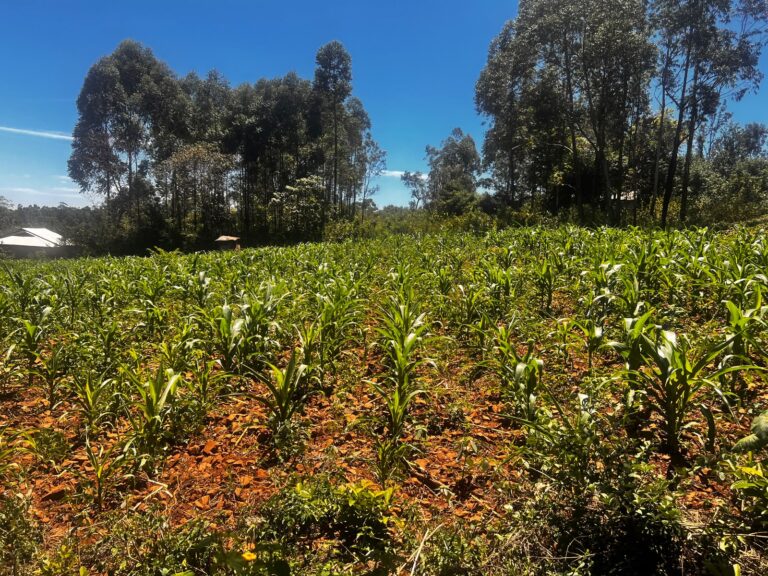
In Mikai, a farming community in Homa Bay County, the agricultural year is written in the hands of women. They grow maize and beans to feed their households, sweet potatoes to sell at market, and sugarcane on leased land in the hope of a steadier income. Each season unfolds as a quiet sequence of consequential decisions about which variety to plant, when to weed, whether fertilizer
is worth what it costs, what to do when the rains fall silent too soon, and when and to whom to sell the harvest.
Kenya’s agricultural information landscape is rich. Government platforms, research institutes, radio programmes, input suppliers and brokers all circulate advice. Knowledge, however, only becomes useful when it meets a particular farm at a particular moment, in a language and form the farmer can act upon.
The women farmers in Mikai described how often the advice they need reaches them too late, after the moment to act has passed. AgriMama AI is the tool the Gweth Foundation is building to bring the right guidance to each farmer at the right time, as part of the Gender & AI Innovation Collective (GAIC) prototyping cohort convened by the A+ Alliance.
Gweth Foundation is a community-based organisation working with women and girls in Homa Bay County. The team is building on a shared Feminist AI Sandbox, which offers open-source language models and a feminist, decolonial knowledge base developed by Women at the Table and Code for Africa.
Listening in the field
AgriMama began on the farm. Susan Maswili spent several days in Mikai alongside women farmers, walking their fields and listening to how they plan, plant, worry, adapt and sell across the length of a season. Their stories carried both resilience and risk. A first-time sugarcane farmer, managing leased land from Nairobi, discovered at harvest that part of her crop had matured months earlier, and learned what it would fetch only days before the sale. A mother who leases land to feed her household planted after radio forecasts promised heavy rains, and now watches young maize through a dry spell with no other source of water to turn to. A sweet potato grower spoke of planting stems that grow harder to find each year, of the high cost of preparing land and hiring labour, and of brokers who buy in bulk at prices that leave little behind. Another woman described crop diseases she cannot afford to treat by trial and error.
These stories show how gender shapes farming in Mikai. Many women lease the land they farm, depend on brokers for prices, and work with very tight budgets while feeding their families. From the fieldwork conducted in the farms, three questions began guiding AgriMama’s design: What is happening on my farm? What should I do next? When should I do it?
The women of Mikai already draw on many voices, from radio and brokers to sugar companies, input suppliers, neighbours and their own hard-won experience. What they seek is guidance that reaches them at the very moment a decision must be made. Their needs stretch across the whole crop cycle, from choosing a variety and preparing the land, through managing water, fertiliser and crop health, to judging maturity, timing the harvest and weighing one market against another. Their goals differ too, since some farm to keep their families fed, others to earn an income, and many to do both.
Guided by an experienced agricultural adviser from the African Centre for Technology Studies (ACTS), the Gweth Foundation chose to focus on two crops that mirror how women in the region now farm. A bag of sweet potatoes sells for around KES 8,000 to 8,500, compared with KES 3,000 to 4,000 for maize, and the crop asks for little fertiliser, so many women now sell sweet potatoes and buy maize for their tables. The prototype will be validated first with maize, the crop that anchors household food security, while sweet potato shapes the longer horizon of market access.
AgriMama AI will be a companion through the seasons. A farmer will begin by registering her farm, her crop, its variety, her location and the day she planted. From there, AgriMama walks beside the crop as it grows, weaving together the farmer’s own observations, the plant’s stage of growth, local weather data and verified knowledge on varieties, pests and diseases. It seeks to offer weekly guidance and timely alerts, and it listens when a farmer asks, “My maize is young and the rains have stopped. What should I do?” For women who tend their land from a distance, AgriMama holds the memory of the season on their behalf, prompting each step from planting through weeding, feeding, watching and harvesting, so that no moment passes unnoticed.
Knowledge worthy of trust
The knowledge that informs AgriMama comes from open datasets on crop varieties, management practices and disease. The team has approached the Kenya Agricultural and Livestock Research Organization and is in conversation with the Kenya National Bureau of Statistics about keeping data current, while NuaSense has opened access to nearby weather station data. The foundation is building first with reliable existing data, and will invest in farm-level sensors once their value is proven. Every source is carefully documented, so the knowledge gathered for Mikai can one day serve women farmers in other places.
AgriMama speaks Dholuo, and it will reach women through SMS on basic phones and WhatsApp on smartphones, where a voice note allows a farmer to simply say what she sees. Testing asks whose realities a system is able to recognise, so alongside agronomic questions the team is including details such as “I don’t hold the title deed to my land,” to learn whether models understand the tenure arrangements that shape so many women’s farming lives. Before the interface takes final form, women will review paper sketches of each screen, remaining co-designers throughout, and a feedback loop will carry their voices back into the tool long after launch.
Much of AgriMama’s foundation is already built, as the prototype can register farmers and their crops, draw on the sandbox’s models and knowledge base, and remember each farmer’s observations over time. Weather integration, a record of past recommendations and the SMS service will follow. More than 50 women in the foundation’s network will be the first to test it, and the team is cultivating partnerships with the county Ministry of Gender and agriculture department, Dholuo and Kiswahili radio programmes, the agro-dealers where women buy their seed, a local organisation that buys sweet potatoes in bulk, and mobile carriers who could make data more affordable for every woman who uses the service.
The next season of work will test these early insights more widely, exploring how common each challenge is, which channel women prefer, and how much trust they place in an automated companion.
AgriMama will be presented in the A+ Alliance prototype showcases in early 2027, carrying with it the voices of the women who helped shape it.
Photo credits: Susan Maswili | Gweth Foundation
Cover Photo: Alan Warburton / https://betterimagesofai.org / © BBC / https://creativecommons.org/licenses/by/4.0/